Showing posts with label 18650 powered. Show all posts

Monday, October 26, 2015

Nitecore HC30 1x18650 battery,Cree XM-L2 LED, REVIEW

Nitecore released many new models this year and is not yet finished with the good news.
 Two new headlamps are coming to diversify the choice in this segment,which was started with the HC50 and HC90. 
The new models are HC30 powered by single 18650 battery and HA20 powered by two AA batteries.
As a Li-Ion battery fan,I am reviewing for you the HC30.I like more versatile flashlights,which can be used in different ways-as a headlamp,or a pocket flashlight.
The HC30 is powered by single 18650 battery,or two CR123A. The switch is on the top end of the body,above the reflector. The reflector is in right angle position to the battery tube.  
 Nitecore HC30.
Cree XM-L2 LED-Cool white(on my sample)
1x18650 or 2xCR123A batteries
98mm (3.86") Length
Weight 86gr. with a 18650 battery

Technical data from the manual.


The switch does not protrude over its retaining ring,but is still accessible without problems.
Impressive deep cooling fins.The LED seems mounted directly to the base of the fins. Great heat transfer design!

Electronic head switch. Not protruding. Good feel,audible click sound.
Great user interface with direct access to Highest mode. Normally starts on the lowest mode.
Modes:
Ultralow=1 lumen
Low=75 Lumens
Mid=210 lumens
High=400 lumens
Turbo=1000 lumens
Peak beam intensity=6600cd

 The switch is an electronically working,which means it has short move with no locked/unlocked position.
The headlamp does have minimum dimensions and weight.
The battery tube is thin and lightweight. The HC30 is impressing with its compactness and low weight from the first time you get it.

The switch is quite big for comfortable pressing it and locating it,too.It produces easy to hear click sound.Not too stiff,not too loose for pressing.
If you afraid of accidental activation of the light,locking out the tail cap is recommended when carrying the headlamp in a backpack,or a pocket.
Of course,you don't want a very stiff hard to press switch when wearing the headlamp on your head,as this will cause troubles when trying to operate the user interface.
My first impressions were: Lightweight,Compact,Comfortable switch,Beam cooler white than expected(also compared to the HC50),Long throw profile of the beam, I like the user interface.
First measurements:
~ 49µA Standby current draw. Tailcap lock out is possible,thanks to the anodized tail threads.

 Nitecore HC30 comes also with a pocket clip.A great option for pocket carrying the headlamp as a regular EDC flashlight,without the headband.

 Perfectly anodized aluminum alloy body.Relatively matte black finish.Excellent knurling,as usual for Nitecore.
Overall great care to detail.

 Tailcap removed. No strong magnet,as seen in other similar flashlights with a similar cap design.
Rectangular cut threads.Anodized-allow physical lock out.
Protected batteries fit with no problems.
Physical reverse polarity protection for improper battery installation.
Even the RP protection I am able to use flat top Keeppower batteries in my HC30 sample. 

This is the HC30's pocket clip(left) compared to the Skilhunt DS10 pocket clip. Very similar form. The loop for strap attaching is not on the proper place and limits the space where a thick belt should fit.
User Interface
Short press starts the light always on UltraLow mode.
Press and hold for a second to activate the last used mode.
Press and hold for more than 1 second to activate Turbo,directly from Off.

Press and hold while On to turn it Off.
Short press will change the mode.

The UI is really well though out,without "exotic" features.
It does not require much to get used to and is easy to operate.
I don't like the difference in switching the light On/Off as this require some more effort(thinking) when doing one of them. I like it more simple-just the same briefly press to turn On/Off.

For one cycling through the modes will be more important,for others turning the light Off quicky with one brief press. Different prefferences.

 I found the UI logic and meeting the requirements for using the HC30 as a headlamp.

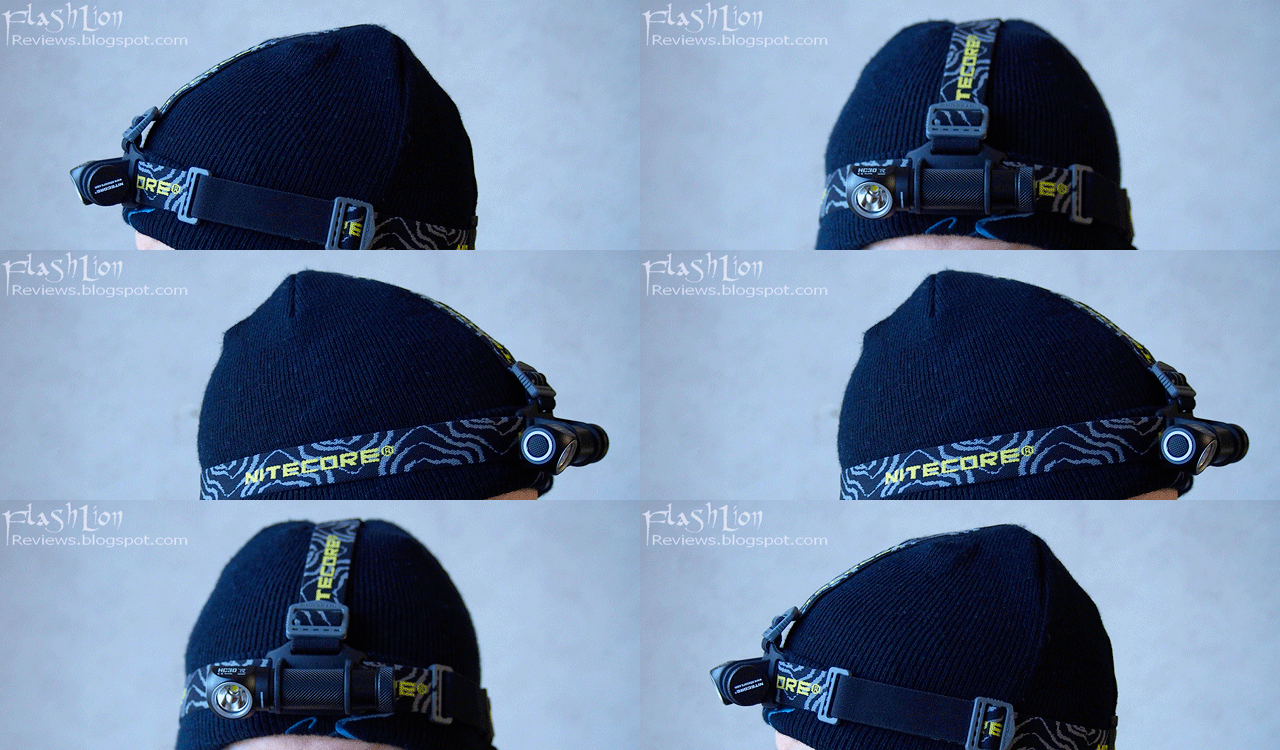
The headband seems quite sturdy.Good thickness and probably enough length for every head size. The holder part is similar to the HC50's relatively soft silicone holder.Maybe not so good in terms of stability,but quite comfortable for the forehead.
The elastic holder eliminates the need of a mechanical components for adjusting the angle of the beam. The two loops do this job well. The "flashlight" stays tight enough in the holder.Accidentally rotating it is hardly possible.

Headband connectors are made of plastic.
Soft rubber headlamp holder.

The headlamp can be inserted in the holder in two directions,allowing operation with the more comfortable hand. 

The HC30 stays quite well on my head,even wearing a winter hat.
Cool white Cree XM-L2 LED.Deep,aluminum reflector with smooth reflective coating.
Very clean glass lens with anti-reflective coating for high light transmittance.

The beam shape is on the throwy side.Some will appreciate that,other not at all. The difference with the wide angle beam of the HC50 is significant.
Personally,I would like to have a diffuser cap for the HC30 for more floody beam. This depend on the way the headlamp will be used.At what distance and environment.
Deep aluminum reflector with smooth reflective surface.

The light from the Cree XM-L2 mounted in the HC30 is cool white. No greenish,or bluish tint in regular use. Clearly defined hotspot. There are artifacts and different tint zones in the hotspot,but should not be visible in regular use.

5 meters, 1/6sec


5 meters, 1/50sec

Run time graph showing the performance on Turbo and High mode.
High mode as expected pretty well regulated.
Turbo mode typical for a single Li-Ion battery flashlight at this output.
The output should be more constant,if using two CR123A batteries.I can't test it,as I don't use CR123A batteries,at all and prefer using just one battery in small flashlights. 
The output is very low at the end,of course easily noticeable that the battery is empty,but if we leave the flashlight unattended,then damaging an unprotected battery is quite possible.

The HC30 shows over 1000 lumens on Turbo mode,at the start in my test.
I can't guarantee full accuracy of my measurements.
Most important is the graph form,showing the performance in the time.
There was no thermal regulation activated in my test,as seen in the Nitecore HC50 review.
The HC30 gets hot after few minutes on Turbo mode. There should be a thermal regulating to adjust the output keeping the temperature in optimal range,but as I already noted,I did not manage to activate it.

According to Nitecore,the HC30 does not feature Low voltage protection,but I still tested it.
To test the driver for low voltage protection,I left the HC30 turned on,as long as possible.To be honest,I really was hoping for a LV protection in this headlamp.There was no such.
The HC30 stayed for some time on a very low output until the battery protection triggered.
I would not recommend to leave the HC30 unattended when using with an unprotected battery.
It is best to use a quality protected battery from Nitecore,or other trusted brand.


 Nitecore HC30 performed quite well in my usage,so far. Good performance as a headlamp.Good performance as a pocket-able flashlight. Well designed. I don't find anything more to want in terms of build quality. What I would change,if it depended on me-a shallower reflector for even wider beam with a less pronounced hotspot(I am a fan of the HC50's beam). This is of course my personal preference,which will differ from the preferences on other people with different requirements
I would like also a warmer light from the LED,which will improve color rendition,making close up work much more pleasant.I am sure many people will agree with me on this point.

In terms of output and regulation,the HC30 also does a good job.The max output is quite enough for almost any situation requiring quality illumination. Good amount of brightness modes,well spaced.The presence of a nice UltraLow mode is a big plus. The UI is great.Direct access to UltraLow and Turbo is really an option nice to have. As in most late Nitecore flashlights,the Stanby current draw is on the high side. It's not that high to bother you,but is definitely something to keep in mind,when leaving the headlamp unused for long periods of time,especially with already used battery.  Using protected 18650 batteries is highly recommended and will add also a low voltage protection for the every day use of the flashlight.
Nitecore recommends using its protected batteries in the HC30 for maximum compatibility-in size and protection.
I like the form factor-versatile and functional.
The headlamp is comfortable on the head,thanks to its lightweight body.
I enjoyed using it in the test period. The switch and user interface work flawless,quickly and without any skipping,or wrong activations.
The HC30 is a good offer in the multi-purpose head lights class.

Thanks to Nitecore for providing the HC30 for test and review!

Thanks for reading!
I hope my review was helpful for you.
If it was,you can help the blog continue and improve by donation.Check out my Contact&Support page.


Sunday, August 9, 2015

Nitecore TM16 (four XM-L2 U2, 4000Lm max, 122500cd) REVIEW

Nitecore TM16 is a new powerful flashlight in the popular Tiny Monster series flashlights.
Featuring big reflector with 4 Cree XM-L2 U2 LEDs and maximum output of 4000 lumens with 122500cd peak beam intensity.
The four LEDs require high voltage supply,so the the TM16 is powered by four 18650 batteries,connected in series.


The Nitecore TM16 is relatively compact,with low own weight. I could say,it's easy to carry and does not load you excessively,when walking with it,in hand.
Weight 700gr. with batteries.
180mm long, 89mm head diameter. ~50mm body diameter.

Specifications (taken from manufacturer)
-Utilizes 4 CREE XM-L2 U2 LEDs
-Maximum output up to 4000 lumens
-Features advanced temperature regulation (ATR) technology
-Boasts a peak beam intensity of 122,500cd and a throw distance up to
700 meters
-Dual-switch user interface ensures one-handed easy operation
-Features 5 brightness levels and 3 special modes
-High efficiency circuit board provides max runtime up to 520 hours
-Integrated power indicator light displays remaining battery power
(patented)
-Power indicator’s secondary function displays battery voltage (accurate
to 0.1V)
-Direct access to ultra-low or turbo ensures flexibility and convenience
-Reverse polarity protection prevents damage from incorrectly inserted
batteries
-Stainless steel retaining ring protects the core components from
damage
-Rear tripod connector brings extra functionality
-Toughened ultra-clear mineral glass with anti-reflective coating
-Constructed from aero-grade aluminum alloy
-Sturdy HAIII military grade hard-anodized
-Waterproof in accordance with IPX-8 (two meters submersible)
-Impact resistant to 1.5 meters
-Tail stand capability


Toughened,ultra-clear glass lens with anti-reflective coating.
80mm Diameter of the lens.


Four Cree XM-L2 U2 LEDs.
For reducing the weight,the smooth reflector is made of plastic.
The TM16 is noticeably lightweight for its size,but using a plastic reflector,sacrifices some percents of efficiency.

The LEDs are not perfectly,but quite well centered for a multi-emitter light. The beam is well focused in one point.
A close up look shows the total round-form reflection of the four LEDs.(the picture below).

Closer look...

A picture with the light on the lowest mode.


User Interface.
Five constant brightness modes,plus 3 flashing modes.
UltraLow-Low-Mid-High-Turbo (in this sequence)+ hidden Strobe-Beacon-SOS

Turbo=4000 Lm / High=1780 Lm / Mid 680 Lm / Low=280 Lm / UltraLow=5 Lm
My lumen measurements(with Keeppower 3400 batteries)
Turbo=3940 Lm / High= 1972 Lm / Mid=707 Lm / Low=300 Lm / UltraLow=5,5 Lm

Two momentary switches. One for ON/OFF. One for mode selecting.
Briefly press the ON/OFF switch,to turn ON/OFF. Press and hold it for more than a second to activate UltraLow,directly from OFF.
Press and hold it while the light is ON-this will turn the light OFF and will activate the blue location indicator light under the switch.This may help you for easier finding the switch in the dark-while the light is OFF. No option for illuminated switch,while the light is ON. The indicator light has no memory and should be activated after each restart.
Pressing the mode switch briefly,while the light is OFF,shows the charge status by the blue switch led. 3 flashes-battery charge over 50%; 2 flashes-voltage under 50%; 1 flash-batteries need to be replaced/charged.

Press and hold the mode switch for more than a second,while the light is OFF,to activate Turbo mode.
While the light is ON,pressing the switch briefly will change the mode. Press and hold it to activate Strobe mode.
Strobe mode can be also activated with double click(mode switch) from OFF.
Switching to Turbo mode directly from any of the other modes is not possible.

There is an instant memory for UltraLow-Low-Mid-High-Turbo modes.
No memory for Strobe-Beacon-SOS modes.

See the actual TM16 user manual- flashlight.nitecore.com

Thew switches can be electronically locked by pressing and holding both,for more than one second,while the light is ON.

Using the dual switch is easy. It is a good size for my fingers and protrude enough for comfortable pressing.
As usual for a side switch,finding it in the dark is hard and requires some time for adjusting the position of the flashlight in the hand.
The blue indicator under the switch may help a little with finding the switch,but not by much. It's very dim and flashing,which makes it not so useful when quick reaction is needed.
Would be great,if the switch was illuminated also while the light is activated.
Close up pictures of the silicone switch cap.

Simple looking,but very sturdy cardboard box with pvc foam inside.
Accessories-Spare O-ring and simple lanyard. Unfortunately,there's no included holster for this model.

One of the anti-roll grooves on the head.
Build quality is as expected,on top level.Great black anodizing,excellent machining-no scratches or defects on my TM16 sample.
The black finish is on the glossy side.

The anti-roll grooves hold the flashlight well on a flat horizontal surface,but not stably enough for sloped surface.

A close-up picture of the tripod mount point at the tail. Standard 1/4 inch thread.
You can also see,the quality of machining is on high level.
Square cut threads.Quality machine work.
Not perfectly anodized,as can be seen on the picture. Tail-cap lock out is not possible,so the not anodized sections of the threads does not matter so much.


Batteries can be inserted without need of battery carrier.
All batteries are electrically connected in series. When inserting them,two of the batteries should be in reverse position of the other two.
Carefully look at the head poles and the stickers showing the right position for each of the batteries.
There are two metal pins on the tail board,that have to be aligned with the two holes in the body.

Every of the negative poles consist two springs for less electrical resistance=easier current flow.

There is a physical reverse polarity protection at the head.Flat top batteries don't contact with the front positive contacts. There is no protection at the tail though,so two button top and two flat top batteries can be used together.


Electronics performance.

Below is output vs time graph.
I usually activate the light and leave it,without pauses,until the batteries became empty.
The TM16 has a high maximum output and as expected it gets hot,after few minutes on Turbo mode.
According to Nitecore,the TM16 features ATR(advanced temperature regulation) technology-a sensor that should tell the driver that the LED board is hot and need reducing the output,to prevent overheating.

I tested the runtime when activating the light on Turbo mode and leaving it on this mode,until it gets very hot.
The ambient temperature was 25C,with light airflow from air conditioner. I did not use a cooling fan in the beginning.
The TM16 gets warm quickly,so I put a multimeter temperature probe between the cooling fins to get some approximate data for the heating.
This method of measuring is not so accurate,but still gives some useful information.
As with the Nitecore EC4,again I did not manage to activate the temperature control of the TM16. I found the flashlight quite hot,after 5 minutes on Turbo mode.Yes the heat transfer is quite good and spreads the heat quickly to the cooling fins,but also to the battery tube.
In my opinion the flashlight is not comfortable to hold after about 10 minutes. I waited to the 10th minute and activated a small 8cm cooling fan,to help with the cooling.Once the flashlight body is hot,it is not so easy to cool it down to normal temperature,without stopping the light,or selecting Mid,or Low output.
This way of operating of course is expected from a high output flashlight. I am not afraid that much to heat the flashlight,but I am concern of heating the batteries,as this may affect their lifetime,at least. This is why I prefer to keep the flashlight with a normal temperature at the tail.
17 minutes after the start,I turned the light Off,to let it cool down for a second start,this time with a cooling fan on max,from the beginning.

I marked the period without cooling with Noc and the period with cooling ac.
Batteries Keeppower 3400mAh.
Note-the temperature probe was not contacting the aluminum surface directly,so all measurements are approximate.

As we can see in the graph,after working 17 minutes on Turbo mode,the max output after restart is 10% lower than the initial.
This means,the light is depending on the voltage. Decreasing the voltage,leads to a lower light output.
Feeding 4 emitters with only 4 18650 batteries is hard without designing a special boost driver,or different way of connecting the LEDs(which will require more powerful batteries than used by me).

The Nitecore TM16 will benefit using IMR batteries,because of their better voltage under high current.Use high current batteries for a higher and more stable output.

Again,as in my EC4 review,I did earlier,the driver's low voltage protection does not trigger,if the voltage of all batteries is not equal,just before they are completely empty. In my test,one of the batteries was with triggered protection.Note that the other 3 batteries were discharged to 2,75V(no load).
There was no low voltage warning from the switch's indicator,or by the main light.

The TM16 operates only by the side switches.They turn the light Off electronically,not physically. This means,when turned Off,the driver is actually in Standby mode and still draws some current,to be possible to react on pressing the switch,again. I measured 132 microAmps Standby current.

The switch features also voltage indication.The blue indicator is blinking when you insert batteries and screw the tailcap. For example,4.2 volts are represented with four-pause-two times flashing.

I don't have any of the direct multi-emitter competitors,like the Fenix TK75.
I could compare the TM16 to ThruNites's TN35 and TN32 lights.
The TM16 is lighter,shorter,with a larger diameter reflector.

Nitecore TM16 and Thrunite TN35 are equipped with different LEDs.
4x Cree XM-L2 Vs 1x Cree MT-G2. Different tint-much warmer for the TN35.
The TM16 is equipped with cool white LEDs. Both flashlights have great lumen output and respectable peak beam intensity.
I could say,these flashlights have very well balanced beams for outdoor use.
TM16=4000 Lm max output,122kcd peak beam intensity.
TN35=2800 Lm max output, 70kcd peak beam intensity.

Let's see from the beamshots I took,which looks better to you-the beam from the big,single MT-G2 emitter or the combined light from four XM-L2 leds.


Beamshots

The poduced light is clean cool white. No visible bluish,or greenish tint.
The beam is well focused,122500cd peak beam intensity. Great distance of throw. The spill is also bright and spread to a wider angle,than the single emmiter flashlights.
At very close distance,the beam has a typical flower shape. This does not affect the usefullness of the beam,at all.Let's not forget,the TM16 is meant primarily for illuminating far objects,outdoor.


All modes 1/20sec, 1 meter distance

5 meters, 1/6sec

5 meters, 1/50sec

I had to soot with 10000 ISO,beacuse of the huge amount of insects. This is why the dynamic range of the photos is not that good.
Distance to the trees ~75 meters.


Distance to the trees ~75 meters.

UltraLow-Low-Mid-High-Turbo modes


In conclusion,this is my view of the weak and strong sides of the flashlight.
Strong: Great initial output; Great build quality;Good design; Lightweight body; Big reflector; Great beam shape for multi-emitter light; Well focused beam with high peak intensity; May be defined as compact size; I am pleased with the UI; Good mode spacing; UltraLow mode;

Weak: Lumen output is decreasing quickly with regular batteries; Not well set-up low voltage protection; No low voltage warning; No timed output step down-the integrated ATR does not work well for me; Direct access to Turbo mode with the light already turned ON,may be very useful; I prefer aluminum reflectors;

The Nitecore TM16 is a great flashlight for outdoor use. I find it comfortable while using in real life situations,with the normal for all side switch flashlights,slow finding the switch. As any other flashlight/product the TM16 has its strong and weak sides.There is no perfect flashlight for anything and anyone. Hope my review gave you useful information and helps for your choice.

Thanks for reading!

Thanks to Nitecore for providing the TM16 for test and review!