Showing posts with label compact. Show all posts

Friday, January 13, 2017

Nitecore P30 Compact Thrower (XP-L Hi,18650) Review +Outdoor Beamshots(updated)

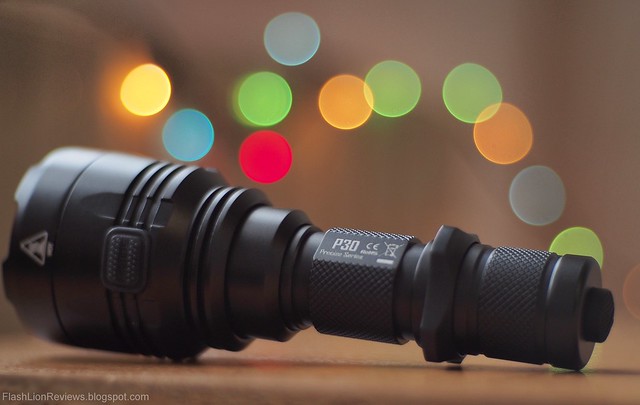
Nitecore P30 is a new flashlight from Nitecore's Precise series lights.It is designed for maximum distance of illumination and compact size for easy carrying.
The P30 features Cree XP-L Hi LED,large smooth reflector and dual switch operation.
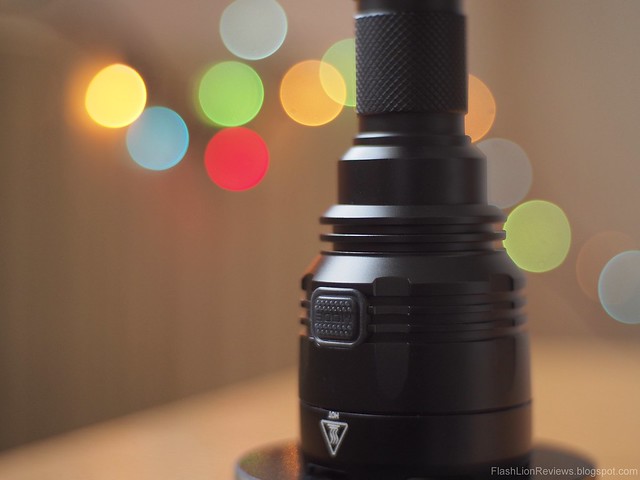
Protruded tail switch allows comfortable On/Off operating,while modes can be selected by the electronic side switch.

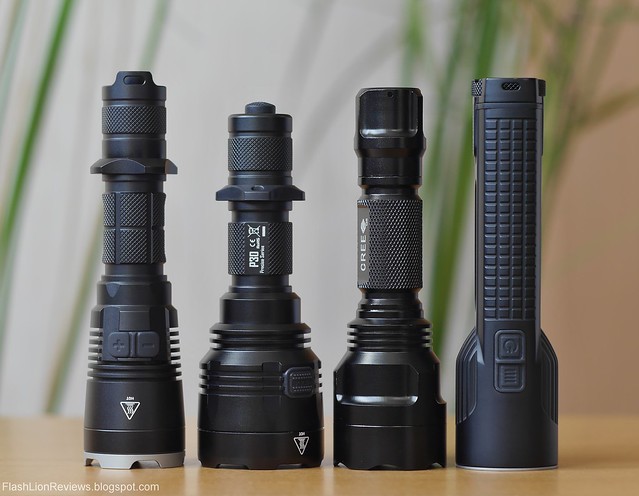
Size comparison with other flashlights with tight focused beam-
Olight SR52UT- Olight M2XUT- Nitecore P30-Nitecore MH27-Olight M23- Niwalker C26


Reflector diameter comparison. Nitecore P30 with 45mm reflector.

Here is anther comparing picture with Nitecore MH27 and Nitecore EC4.
I added also maybe the most popular and well known budget flashlight-the classic UltraFire C8.
It is hard to not think about the C8 design while looking at the P30,as the designers idea is the same-maximum compact 18650 sized flashlight with wide and deep reflector for high beam intensity(high distance of throw).

In my medium size,very thin hand. People with very big hands may find the body a little shorter than the optimal for best grip.The P30 fits well in my hand and I found it sufficiently comfortable,especially with the grip ring. I was extremely happy to see a C8 style flashlight coming with a grip ring-however my happiness was shortly cut by a fact which I will write about later in the review.
The P30's tail cap is specially designed for quick and easy access to the switch.
It is very well rounded,without any sharp edges. The switch can be easily pressed even when wearing gloves.

Below are pictures of the official instruction sheet coming with Nitecore P30.


This is the package and the accessories.
Two spare O-rings,spare tail switch cap,lanyard,battery magazine for two CR123A.
Good holster and pocket clip are also included in the set.


Nitecore P30 supports one 18650,two CR123A and even two RCR123A for stable output.

My lumen measurements show:
Turbo mode 864Lm initial, 824Lm after 30sec. (about 900Lm with IMR battery)
High mode 470Lm
Mid mode 240Lm
Low mode 62Lm
UltraLow mode 1Lm
Batteries used for the test Keeppower 3400/3100 mAh.

Peak beam intensity:
(measured at 5 meters)
Nitecore P30 Turbo mode 88,750cd 95,000cd 30sec after activation (retested with a second sample of the P30 with much better centered LED)

For comparison:
Nitecore MH27 = 43,750cd (XP-L Hi)
Olight M2X UT = 171,000cd (XM-L2 de-domed)
Olight M23 = 37,500cd (XM-L2 de-domed)
Olight SR52 UT = 191,250cd (XP-L Hi)
Niwalker C26 = 52,500cd (XP-L Hi)

Watch my quick video demo below.

Nitecore P30 disassembled on its three main parts.
In terms of build quality and machining the P30 is on the expected for Nitecore high level.
There are no sharp edges,dents or scratches on my sample.
Perfectly done anodizing,as well.

Beautiful looking front of the flashlight exposing the large reflector,secured with a relatively thin bezel which makes the reflector looks even bigger.
The bezel is not designed with aggressive shape and is crenelated just enough for some light to pass when the flashlight is left on a flat surface.

Cree XP-L Hi LED,aluminum reflector with smooth reflective surface.
As you can see on the picture,the reflector is not absolutely smooth.It has some circular texture probably for better mixing of the beam.

Purple color anti-reflective coating.


Well machined front threads-anodized,rounded rectangular-cut type.
No spring or physical reverse polarity protection on the positive contact this time.
Button top and flat top batteries can be used. All batteries that I have fit well in the battery tube.

Well made rounded triangular-cut threads at the tail end of the battery tube.
You can take also a closer look at the often controversial grip ring.
A little unexpected,the grip ring is made of plastic,which material many times was proved to broke easily.
In the case of my SRT6,the ring broke just from the different expansion of the different materials-metal and plastic while the ambient temperature is changing..
I have no information about the actual reason for choosing again the old type plastic ring in this flashlight after the metal ring for the MH27 and hope it will be replaced with a metal version in the next batch.
The grip ring is being locked when the tail cap is tightened and does not spin freely.
It provides the only lanyard whole,as well.


Full user manual from Nitecore's website-
http://flashlight.nitecore.com/html/uploads/ueditor/image/product/P30/P30_UM_EN.pdf


Runtime Performance
As most of the latest flashlights coming from Nitecore,the P30 features ATR technology.
This is advanced temperature regulation which has the purpose to adjust the brightness according to the current temperature of the LED board.
In my tests so far the different models performed in different ways-some of them keeping the flashlight output high despite the high temperature,others decreasing the brightness with a step down reminiscent of programmed timed step down.
In the P30 the ATR technology clearly shows its work.
I tested the flashlight 3 times on Turbo mode and once on High mode.
First run was on Turbo mode with a small cooling fan which helps to keep the P30 optimal cool to track its maximal performance(high initial output as long as possible).
I found the fan accidentally stopped before the 10th minute after the start.
I don't know how long it was off,but I turned the fan again on to track the rest of the runtime.
This is the Orange curve in the graphs below.
The second run(Green curve) is again Turbo mode,this time with the fan constantly working.
As can be seen from the curves,the P30's ATR does decrease the brightness down to the 470 lumen High mode.
If the temperature is still low after the first minutes,the driver decreases its output to about 630 lumens and keeps this output as long as the battery can keep its voltage stable.
If the temperature is high,the output will be decreased to 470Lm level until lowering the temperature.
When the temperature is again on the threshold level,the output is unlocked to the maximal possible according to the battery's voltage.


Third test(Red Curve) was done without additional cooling. The ambient temperature was about 18 degree Celsius. According to the higher LED temperature the P30's electronics decreased the output to High mode and did not recover it anymore.
As expected with a high output between 800 and 700 lumens the P30 runs hot.However at not so high ambient temperature,I would like a little higher threshold temperature for the step down.
Yet,I can't test every possible scenario but my experience with other flashlights tells me that is possible to allow a little more time on Turbo mode without activation of the ATR.
Overall I am pleased with the presence of ATR in many of the latest flashlights as this is the right way to more efficient lighting. The ATR unlocks the potential of the flashlight allowing optimal brightness in the cold nights outdoors,when the flashlight is less likely to overheat. On the other side in the warm summer nights,the ATR will effectively protect the flashlight from excessive heating.
These are only the first 50 minutes of each run time curve,for easier comparison.

This graph compares Turbo mode with the High mode.
We can see that Turbo mode step down is exactly to the output of High mode.
High mode(Green Curve) was done without external cooling. Brightness is almost constant for 130 minutes when tested with a Keeppower(Panasonic)3400mAh battery.

Nitecore P30 features back-lit side switch which supports Low voltage warning and battery voltage reading.
The switch is flashing in blue color when the voltage is too low and the battery  has to be replaced.
Low voltage protection is not available.The output is very low at the end of the discharge and give us some time to find another battery. It is recommended though to use protected batteries as in case of leaving the flashlight activated for a long period,the battery will not be critically discharged.

I don't detect PWM regulation in my tests.The output should be constant current controlled.


Beamshots

Beam comparison with a few other good throwers-
Nitecore MH27 (Cree XP-L Hi)
Olight SR52UT (Cree XP-L Hi)
Niwalker C26 (Cree XP-L Hi)
Olight M23 (de-domed XP-L version)
Olight M2XUT (de-domed XM-L2 version)

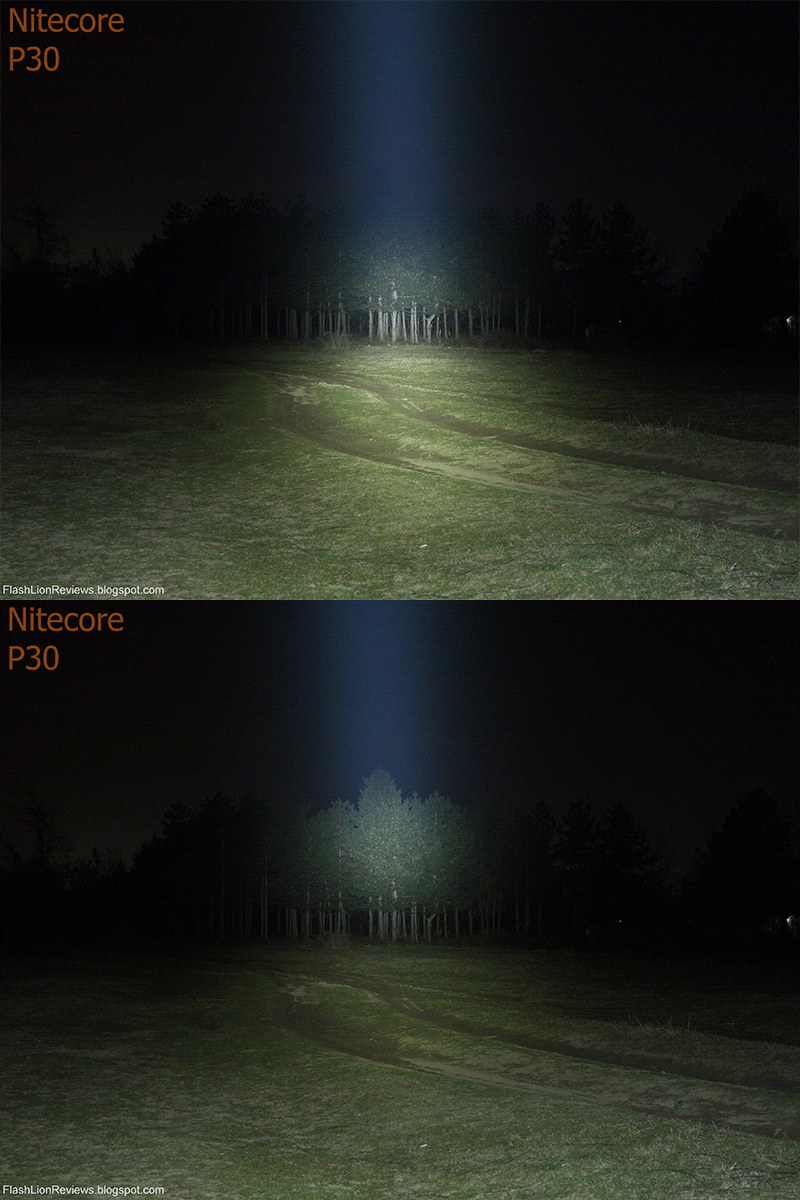
The beam from Nitecore P30 is well focused cool white light with very bright hotspot and corona.
There is also not so bright but usable spill.
Thanks to the factory flat LED the light is clean white without any greenish or bluish tint.

3 meters
1/6sec Nitecore P30 all modes+ beam comparison with other popular flashlights

Thanks to the form of the reflector and its micro textures,beam of the P30 is well controlled in all zones.
High intensity hotspot,smooth transition with the corona and no noticeable artifacts or circular patterns.
The light from the X-PL Hi is Cool white,but as you can see from the test pictures,it is not on the extreme high end of the Kelvin temp and appears slightly warmer white than the other lights with Cree XP-L Hi Leds-the MH27,C26 and SR52UT.


3 meters
1/50sec

3 meters
1/250sec
Notice how the larger reflectors of Olight SR52UT and Olight M2XUT result in brighter hotspot with thinner corona. The M2XUT on its side with a de-domed XM-L2 Led shows much less corona than the SR52UT with XP-L Hi Led,though sacrificing its beam color temperature.
Yet,the Cree XP-L Hi packs clean white light with higher overall lumen output. 

3 meters
1/1600sec
The M2X and SR52 beat the P30 thanks to their larger reflectors.
The MH27 has a little higher output but its reflector is smaller diameter and provides less hotspot intensity.


Outdoor Beamshots


Distance to the trees 85 meters.

Beam intensity and profile comparison.
Flashlights-
Nitecore P30 - Olight M23 - Niwalker C26 - Nitecore MH27 - Olight SR52 UT - Olight M2X
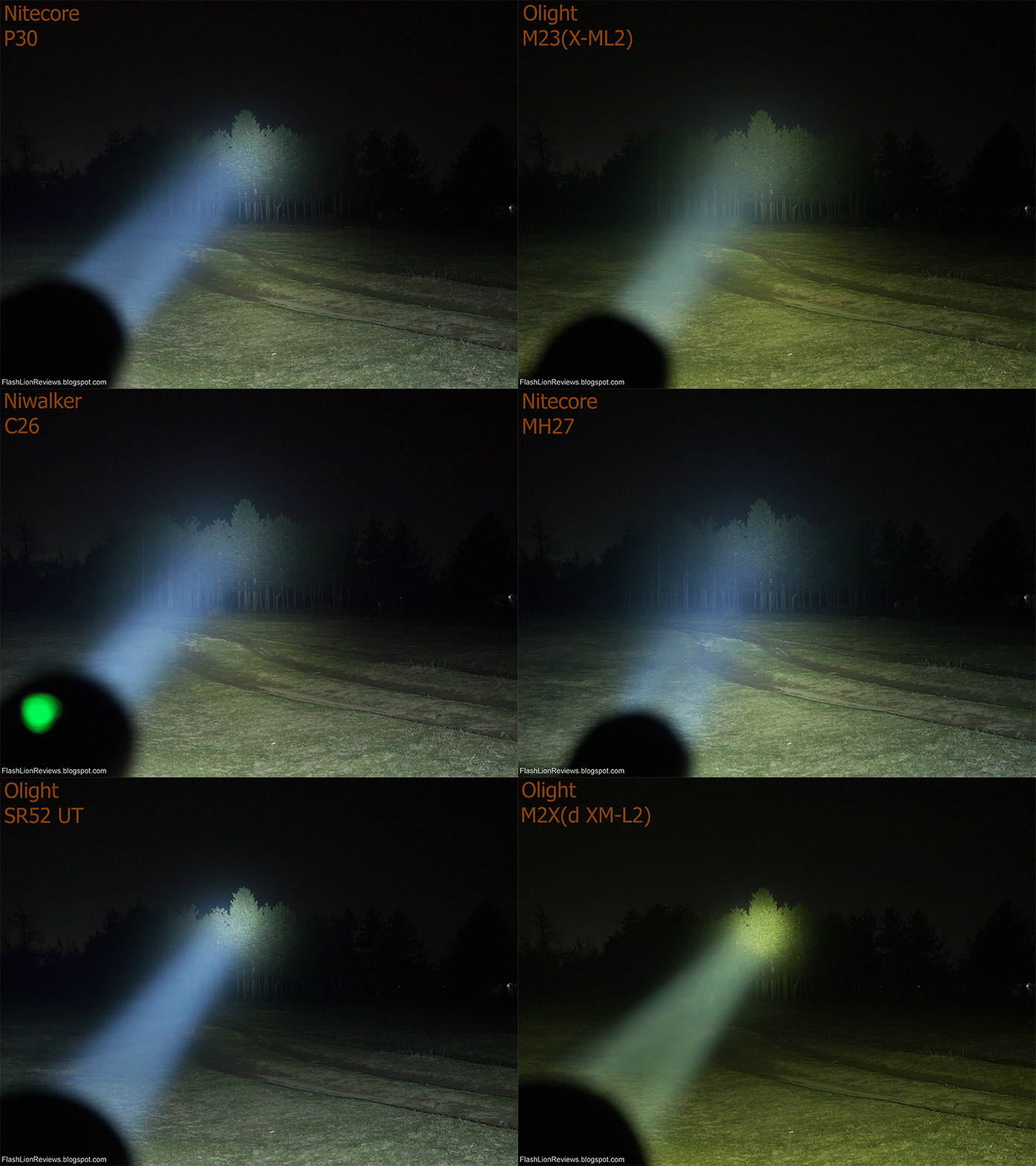
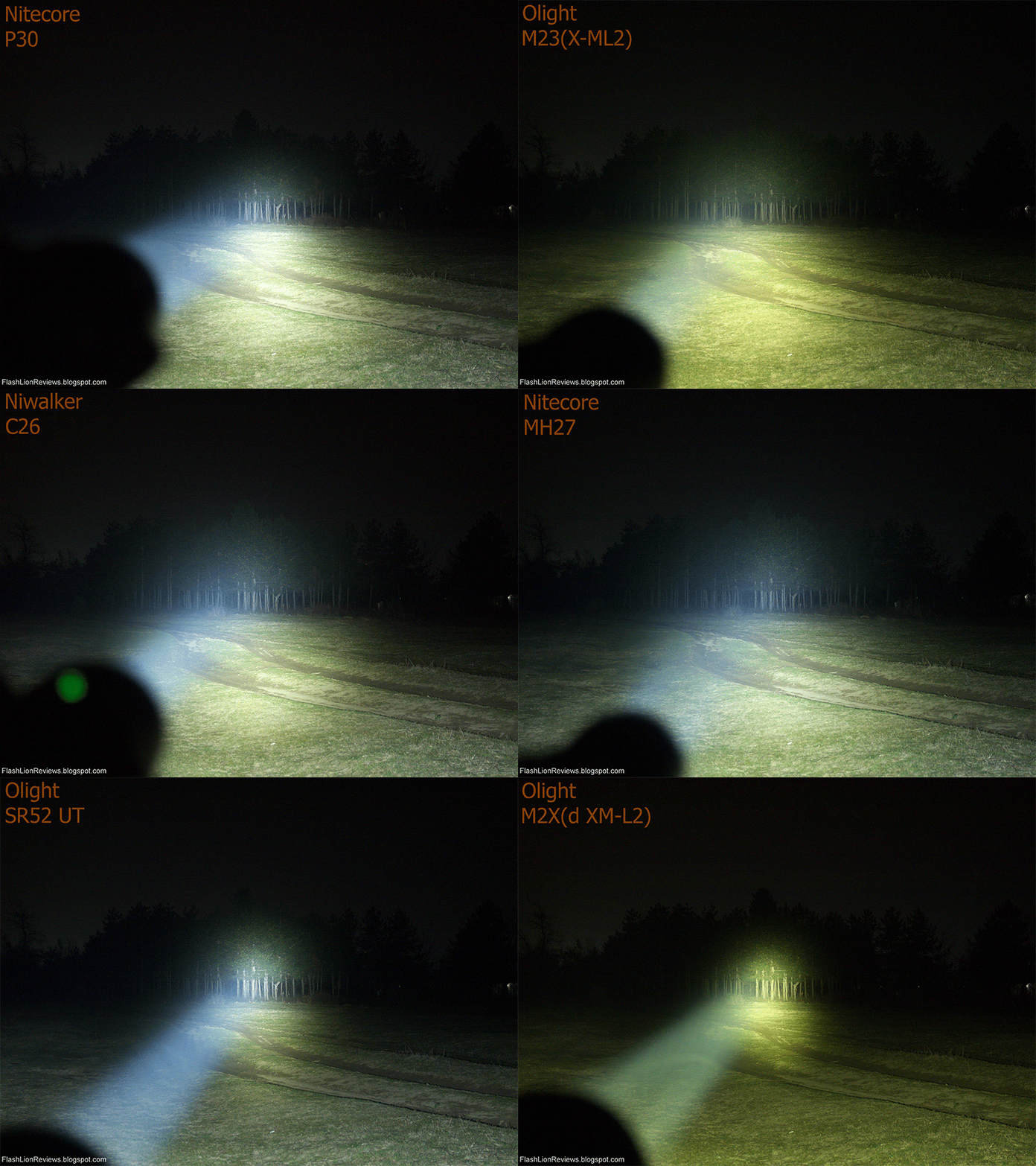


As can be seen on the comparison pictures Nitecore P30 serves pretty well outdoor,delivering useful light on quite long distance. If longer throw is needed,a flashlight with larger reflector should be selected.
The strength of the P30 is its compact size and very well focused beam thanks to its large diameter reflector and the latest flat dome Cree XP-L Hi LED.
The flashlight can be easily defined as pocket-able(yes,it is not a small EDC light,but if you need good throw for some reason,Nitecore P30 is one of the best choices).
What could be improved? As already mentioned,the grip ring is made of plastic,which is known to not be reliable material for this part.
The clip is again nothing special in terms of design and way of mounting.However some people may like that it is press,pull removable and probably easier to find a spare one than if it was more special.
The side switch takes more effort than needed to find it in the dark. If you like to change the light mode regularly,with the P30 this may happen slowly,as the main ON/Off switch is on the tail and you have to use two hands or to change the grip with following finding the side switch by touch.
The good is that as a high positioned flashlight the P30 remembers the last mode without any delay.
It is pleasure to use it as a single mode thrower flashlight. The tail switch allows momentary On,useful for signalling purposes.
I am glad to see the thermal regulation operating well too.

Feel free to post a question or comment below.

Nitecore P30 was provided by Nitecore for test and review.

Friday, December 30, 2016

Upcoming Nitecore P30 Review HNY

Check out the full review in progress here- http://flashlionreviews.blogspot.com/2017/01/nitecore-p30-compact-thrower-xp-l.html

Happy New Year!
Have a nice and successful new 2017!
Thanks to all flashlight fans for reading my reviews!


Size comparison:
Nitecore MH27, Nitecore P30, UF C8, Nitecore EC4


Large aluminum reflector. Cree XP-L Hi LED.
Watch my quick video demo below.


Tuesday, December 6, 2016

Fujian 35mm f/1.6 CCTV Lens on m4/3 camera- Test and Thoughts


I was thinking a lot about these widely offered CCTV lenses on ebay and other webshops.
Available in 25mm,35mm and 50mm with apertures of about f/2 these low priced lenses look nice bargain for low light photography and producing nice blurred background in portraits when used on a micro4/3 cameras..
However,the CCTV lenses,especially the cheap ones are not meant/designed for serious HQ photography and the presence of various optical flaws is guaranteed.
The expensive large aperture alternatives from Olympus and Panasonic are out of my reach,so the thoughts bellow are not based on comparison between totally different class lenses.

In terms of design I found the 25mm and 35mm pretty unattractive and looking as a toy.The 50mm one is too long for easy portraiture and requires to stay far from the subject. I already have the SMC Pentax 50mm f/2 and the Helios 58mm f/2 lens,so there was no need for another 50mm lens.
Then came this new version of the 35mm lens and I liked it from the first look. Very compact with a good lens looking form.The previous version has looked like a piece of tube to me.
At the time of purchasing this lens was offered only from one seller on ebay.I bought it for $30 with two extension macro rings and CCTV to m4/3 mount adapter included.

Knowing from different reviews that this CCTV lenses produce pictures with very soft corners,I was also attracted from the fact that this new version is described as APSC compatible,which gave me some hope that on a micro4/3 camera this effect will not be so noticeable.Read about that below...


Let's start with the pros-
Full metal body. In comparison kit lenses like the Olympus 14-42 entirely made of plastic,look like toys and cost 10 times more.The metal body of this lens even not machined on the highest level gives really nice feel on the construction and definitely brings some more trust in its reliability.
As you can see from the pictures,all needed markings are engraved on the body.
 This is a manual operation only lens so it has full manual mechanical aperture ring(big plus in many cases) and manual focusing ring. Both rings operate very smoothly and consistently.Twisting the focusing ring is tight but not so much to be uncomfortable and prevents unwanted de-focusing.
There are markings only for the full f stops. The focusing ring has nice relatively short rotation which allows quick focusing and nice smooth operation in videos.
 The minimum focusing distance is 50cm.Not very good for macro use,but don't forget that this lens comes with two macro rings ready for use.
The center sharpness is really good and in my tests beats the Olympus 14-42 kit lens with much.

The aperture ring is this with the f markings.There are some grooves on its sides.
The focus ring is this with the distance scale and the grooves above it.
To sum up-the zone with the 35mm f1.6 marking is stationary and is used for indication of the two aperture and focus ring rotation.

The C mount to micro4/3 adapter is well machined and fit pretty well on different cameras,without gaps.
Locks well on my cameras.Blends with the camera body quite well and does not look bad at all.


Another really attractive feature is the 12-blade aperture.
The advantage of this-rounded out of focus lights(bokeh) even with the aperture closed.
Another great feature is the click-less aperture ring without defined positions.
Great option for video shooters.Allows easy and precise adjustments of the aperture while filming possibly undetectable by the viewer.
The front filter thread is 37mm compatible.

Here is a close look at the aperture blades.
Not perfectly symmetric,but with great final result.


Below is a size comparison with the Olympus 14-42 lens and SMC Pentax 50 lens(without adapter).
The Fujian lens in the center is also without adapter.

A look at the diameter and max aperture of the lenses.

Here the Fujian and Pentax are with partly closed apertures,easy to check the expected bokeh shape.
6 blades on the Pentax lens vs 12 on the Fujian.

IMO well looking on different cameras,compact and not distracting.

Cute on the E-PL5.

Here we start with the disadvantages of using a very low priced lens with large aperture designed for different devices-CCTV security cameras.
Above is an example picture taken with the Fujian 35mm.
Center sharpness is great-quite descent for most users in most cases.
The corners on other side are not well rendered. Blurred with a kind of whirlpool effect.
Taking series of test shots on an improvised test chart I found my copy of the Fujian 35mm to suffer from de-centering at its largest apertures,f/1.6 and f/2.
I mostly use it at the reasonable good f/2.8 and f/4.
If you like to shoot videos handheld,camera bodies with build in stabilization compensate the shaking easily on short FL lenses like this. 

Samples
I see no real difference between f/1.6 and f/2,so I skip f/1.6 in some of the examples.
Click on the images to see them fullscreen.


The larger the aperture,the narrower sharp zone with circle shape.
Most images are taken before sunset and there is not much green at that time of the year.

Depth of field in portraits at f/2.8 with a m4/3 camera.
Click on the pictures for larger view.

Macro shots with one extender.


Pictures at different aperture.
 f/2  1/800s  ISO 160


f/2.8  1/640s  ISO 160


f/4  1/320s  ISO 160


f/5.6  1/200s  ISO 160


f/8  1/125s  ISO 250


f/16  1/125s ISO 5000


Shape of the Bokeh effect at different aperture.


Some test chart shots.
Remember,just don't expect too much from this type of lens.
Edit-After some more tests with Panasonic G6's focus peaking,I found that the lens itself has no problem with the corner sharpness. The corner rendition is quite sharp.The actual problem of the lens is that the center and the corners are in focus at a different point,even at f/8. If I intentionally focus on an object in the corner,it is sharp,but then the center is soft/blurred/out of focus.
The focusing zone is like a corona that expands its diameter from the center to the corners depending on the focus point. (I will try to do a video for better demo)

f/1.6  1/320sec
f/2  1/320sec
f/2.8  1/250sec
f/4  1/160sec
f/5.6  1/80sec
f/8  1/30sec
f/16  1/2sec -corner to corner sharp,but diffraction limits picture quality a lot.


Video test
Aperture test-testing the exposure difference at each aperture marking on the lens.


Manual focus test at f4


Aperture priority test, auto ISO

Who will enjoy using this lens?
People that understand the limits of using a low priced product and know how to take the best out of their gear. People that do not expect too much from a cheap lens.
This lens is a great option to train your manual focus skills; To test if the shallow depth of field at large aperture suits your way of shooting; To learn more photography techniques using different aperture values(especially if you were using only small aperture kit lenses; For example shallow depth of field allows you to blur distracting/ugly background,bringing the whole attention to the main subject of the image.
The lens is good for people that like art looking photos and don't expect corner to corner tack sharp images.

For me sacrificing the corner quality,but taking low light videos more easily also worth it.
With everything said,I would not recommend the lens to people seeking very high optical quality represented in corner to corner sharp images.It should be avoided by landscape photographers unless their goal is initially giving the scene more artistic look(which in our days is quite easy to do in computer software).
The performance on f/2 and f/2,8 can't match dedicated lenses and more especially the more expensive ones-usually all large aperture native lenses for the particular mount are quite expensive. The vintage Helios 58mm and Pentax 50mm lenses beat the CCTV lens with much in terms of optical performance. But they are full frame lenses and the comparison with a lens dedicated for much smaller sensors is hard.
Let me know about your experience with CCTV lenses in the comments don't forget-practice and understanding the gear is the way for improvement and enjoying the photography.


What's positive:
+Compact; Simple but effective barrel design;Looks well on different cameras;
+Solid metal feel; Stable focus and aperture ring with smooth 'fluid' rotation;
+Not limited to the regular f/ stops;
+Great for practicing manual operation;
+Enjoyment to take some low light photos,some nice portraits and videos with precise focus pull;

What's negative:
-It is hard to tell what aperture is set without looking at the f ring;
-As expected from a cheap lens(and not only) apertures of f/1.6 and f/2 are hardly managed and we can see various flaws-distortion,chromatic aberration,overall loss of sharpness,blurred corners,slight decentering;
-Simple anti-reflective coating;Bright light at certain angle may cause overall purple tint of the scene;
-Using  sun hood is a good idea;
-Vignetting is not as noticeable as expected,yet I can test it only on micro 4/3 sensor; On a APSC sensor there should be more vignetting and corner softness;
-I don't see any difference between f/1.6 and f/2 on a m4/3 sensor camera from my tests so far;
 Don't have a way to test it on a larger sensor and comment; Cameras measure the same amount of light and select identical settings for both apertures;

Thanks for reading.I hope you found some useful info.
Your comments are welcome-share your thoughts of using CCTV lenses.